Sunday, August 21, 2011

6:56

Salaam all,

Qul innee nuheetu an aAAbuda allatheena tadAAoona min dooni Allahi qul la attabiAAu ahwaakum qad dalaltu ithan wama ana mina almuhtadeena

The Aya says:
Say (O Muhammad): I was forbidden from worshipping those whom you (plural) call upon, short of Allah. Say (O Muhammad): I will not join and follow your desires, I would have gone astray then and not amongst the guided.

My personal note:
I have translated the term AHWA as desires in this section and that covers the meaning. However, the meaning of the term goes beyond desires to any form of bias that we stick to but has no basis to stand on.


The term hawa then carries with it all sorts of considerations where we are always asked, through Taqwwa (consciousness), to question why and what are the basis upon which we hold onto something so dearly? The basis for the Muslims have to be anchored deeply and strongly in the teachings of Allah to us and in the teachings of His messenger (pbuh).

Translation of the transliterated words:
Qul: Say/ communicate/respond
Note: the root is Qaf-W-L and it means saying or communicating. QUL is an order or a request addressed to a singular. It means: say or communicate.

Innee: I
Nuheetu: was forbidden/ was ordered to desist
Note: the root is N-H-Y and it means stopping or ending or desisting. This then takes different form according to the plane of thought of the sentence. NUHEETU is an action that is being completed. It means: the action of asking the object (first person singular) desist or cease what they are doing happenedby the subject (undeclared).

An: that/ to
aAAbuda: worship
Note: the root is Ain-B-D and it means slave or servant. aAABUDA is an action that is being completed or will be completed. It means: the action of making oneself slave is happening or will be happening by the subject. Conceptually, the term of “making oneself a slave” suggests becoming a slave voluntarily to an entity and that is the term used for worship since the main way for a person to make himself or herself a slave of an entity voluntarily is through love of that entity and through being in awe of that entity.
Allatheena: those whom
tadAAoona: you (plural) call upon
Note: the root is D-Ain-Y and it means calling as in calling someone for help or otherwise. TADAAooNA is an action that is being completed or will be completed. It means that the action of calling or calling upon is happening or will be happening by the subject (second person plural) of the object (Aghayra Allah= other than Allah?) .

Min: from
Dooni: short of/ below of
Note: The root is D-W-N and it means short of someone or something. It can also mean lower than at times depending on the plane of thought of the sentence. DOONI means short of or below of. Allahi: Allah
Qul: Say/ communicate/respond
Note: the root is Qaf-W-L and it means saying or communicating. QUL is an order or a request addressed to a singular. It means: say or communicate.
la attabiAAu: I do not/ will not join and follow
Note: La is for negation of the action to come. ATTABiAAu is derived from the root T-B-Ain and it means following footsteps or join and follow footsteps. ATTABiAAu is an action that is being completed or will be completed. It means: the action of making oneself follow footsteps or join and follow footsteps of the object AHWAAKUM= your desires/ biases) is happening or will be happening by the subject (first person singular).

Ahwaakum: your biases/ airas/ desires
Note: the root is H-W-Y and it means what is between the earth and the sky and that is air and emptiness for the Arabs. Conceptually, it stands for desire because that is associated with air for Arabs. It also can apply to any entity that is not supported by a firm base, including ideas and unsupported biases. AHWAA means airs or biases or desires of. KUM is plural you.

Qad: indeed
Dalaltu: I became lost
Note: the root is Dhad-L-L and it means getting lost as in lost the path or road in concrete terminology. Conceptually, it is used for any form of loosing the path, whether it is the path to a location or to the truth, or to be correct spiritually and so on. The imagery is very strong since loosing the path in the desert can mean near certain death. DALALTU is an action that is completed. It means: the actions of loosing the path, or becoming misguided happened by the subject (first person singular).

Ithan: then
Note: the term QAD DALALTU ITHAN carries the meaning: “Then I would have become lost”
Wama: and not
Ana: I
Mina: of/ from/ amongst
Almuhtadeena: the guided ones
Note: ALMUHTADEENA is derived from the root H-D-Y and it means gift in all it’s forms and it carries the meaning of guidance since guidance is a gift. ALMUHTADEENA are the guided ones.

Salaam all and have a great day.

Hussein

Thursday, August 18, 2011

6:55

Salaam all,


Wakathalika nufassilu alayati walitastabeena sabeelu almujrimeena

The Aya says:
As as such, we make the signs clearly distinct and in order that the path of the criminals become clear.

My personal note:

I translated the term nufassilu Al Ayat as “making the signs clearly distinct”. The term nufassil is derived from the root F-Sad-L and it means making a clear distinction between one entity and another. It applies to the joint where it separates one side or the other and in other areas. So, Tafsseel is making it clear which is which. To, me that signifies the ability to distinguish the applications and understandings of the different Ayat.

Often times this term is translated as “Detailing”. It does apply to the term but more in the form of clearly identifying the different parts that need to be identified as separate and distinct, as in the detailing of the work of the builder and so on, rather than spelling every single “detail”.

Translation of the transliterated words:
Wakathalika: and as such
Nufassilu: We detail/ we distinguish
Note: the root is F-Sad-L and it means what makes the two things or more distinguishable from one another. This can be because of separation or because of joint or change of color or angle and so on. The action is more of distinction. NUFASSILU is an action that is derived from the root. The action is being completed or will be completed. It means that the action of distinguitiong or detailing of the object (ALAYATI= the signis)is happening or will be happening by the subject (first person plural).

alayati: the signs
Note: AYAT is derived from the root Hamza-Y-H and it means sign. ALAYATI means the signs.
Walitastabeena: and in order to become clarified
Note: WA is a letter that links what is before with what is after. This link is through inclusion, either one is included in the other or they are all included in the bigger sentence or bigger picture. WA often corresponds with “and/ addition” but the more encompassing meaning is in inclusion one in another or all in a bigger picture or sentence. LI means to or in order to. TASTABEENA is derived from the root B-Y-N and it means between. This word then assumes many meanings as separation and distancing between two or more things. It also carries the meaning of clarification between two things. Here, it adopts the meaning of clarification. TASTABEENA is an action that is being completed or will be completed. It means: the action of becoming clear is happening by the subject (third person singular pointing to SABEEL ALMUJRIMEENA= path of the guilty).

Sabeelu: path of
Note: the root is S-B-L and it means and it means flowing water from the falling rain from the sky to the flowing water in the river and so forth. This is the concrete and the other uses are related as in path, which allows the flow, to soft flowing hair and so forth. SABEELA is the flowing water or the path of.

Almujrimeena: the guilty/ the criminals/ the severers of good ties
Note: the root is J-R-M and in concrete it means: harvesting the dates from the tree or separating/severing the dates from the tree. Conceptually, this word then carries many other meaning including a transgression because the transgression/criminal act is a separation or severing of ties with what is appropriate. ALMUJRIMEEN are the ones who sever ties and those are the criminals and the guilty parties.


Salaam all and have a great day

hussein

Sunday, August 14, 2011

6:54

Salaam all,


Waitha jaaka allatheena yuminoona biayatina faqul salamun AAalaykum kataba rabbukum AAala nafsihi alrrahmata annahu man AAamila minkum sooan bijahalatin thumma taba min baAAdihi waaslaha faannahu ghafoorun raheemun

The Aya says:
And when those who make themselves safe in our signs come to you (singular) then say: “Peace be upon you (plural). Your nurturing Lord had mandated upon Himself the mercy. That whomever did a bad deed in ignorance, then he repented after that and acted beneficently, then He (Allah) indeed is protectively covering, Merciful”.

My personal note:
The early scholars of Islam commented on the term “did a bad deed in ignorance” and according to the opinion of Ibn Abbas (r) who is considered the translator and first commentator on the Qur’an, the term touches all sins big or small. Because all sins are a product of some form of ignorance.

However, the other important factor is repentance or leaving the sin or intending to leave it and returning to the fold of your Lord. May Allah help us always return to Him no matter how great our sins.

Translation of the transliterated words:
Waitha: and when/ and if and when
Jaaka: came to you (singular)
Note: the root is J-Y-Hamza and it means coming. One concrete word that is derived from this word is the pool where the rain water comes. JAA is an action that is completed and that is derived from the root. It means that the action of coming happened by the subject (third person singular or plural pointing to ALLATHEENA YUMINOONA= those who made themselves safe, coming up) to the object (KA=singular you)
Allatheena: those who
Yuminoona: make themselves safe/ trust
Note: YUMINOONA is derived from the root Hamza-M-N and it means safety. Conceptually, it can also be extended to trust as well, because we feel safe in the entity we trust. YUMINOONA is an action that is being completed or will be completed. It means: the action of making oneself safe is happening or will be happening by the subject (third person plural).

biayatina: in Our signs
Note: Bi denotes that what comes after is a tool and/or an object or an association with an action that was mentioned. If it is an object of the action then it makes it stronger. AYAT is derived from the root Hamza-Y-H and it means sign. AYATI means signs of. NA means Us or our.
faqul: then Say/ communicate/respond
Note: FA means then or therefore or so. QUL is derived from the root Qaf-W-L and it means saying or communicating. QUL is an order or a request addressed to a singular. It means: then say or communicate.

Salamun: peace/ dissociation from harm
Note: the root is S-L-M and it means dissociation from an entity to re-associate with another that is better. This carries the meaning of health and safety. It also carries the meaning of delivery from one to another and it carries the meaning of peace, since it is the dissociation from harm to peace. SALAMUN means peace or dissociation from harm.
Aaalaykum: upon you (plural)
Kataba: He wrote/ He mandated
Note: the root is K-T-B and it means putting together of things or beings and so forth. It is understood as writing because writing is the putting together of letters, words and ideas. KATABA is an action that is completed. It means: writing happened by the subject (third person singular pointing to Allah). Writing can take one of two meanings: one is decree and the other is the meaning of pre-knowledge/documentation but not necessarily a decree or it can be both. In this context it is taking the meaning of mandating or decreeing.

rabbukum: your nurturing Lord
Note: RABBUKUM is derived from the root R-B-B and it means nurturing and Lordship as two components of the meaning that can be present together or one at a time according to the context of the sentence. RABBU is nurturing Lord of. KUM means plural you.
Aaala: upon
Nafsihi: himself
Note: NAFSIHI is derived from the root N-F-S and it means to breath. This is the concept and then it can extend to self or anything that breathes. NAFSI means self of. HI means him.

Alrrahmata: the mercy
Note: the root is R-Ha-M and it means womb in concrete. This term is used to mean mercy and all the good that the womb provides. RAHMA is the womb-like mercy.


Annahu: that
Man: whomever
Aaamila: did
Note: the root is Ain-M-L and it means doing or work. aAAMILA is an action that is being completed or will be completed. It means: the action of doing or making happened by the subject (third person singular).

Minkum: of you (plural)/ from you/ amongst you
Sooan: bad deed/ ugly deed/ disliked deed
Note: the root is S-Y-Hamza or S-W-HAMZA and it means hated word or deed. It can also conceptually mean ugly or vulnerable. All the meanings are linked somehow by one concept. This word then means different things according to the plane of thought that is being talked about. SOOAN is a bad or ugly or disliked deed.
Bijahalatin: in ignorance/ in lack of knowledge
Note: Bi denotes that what comes after is a tool and/or an object or an association with an action that was mentioned. If it is an object of the action then it makes it stronger. JAHALATIN is derived from the root J-H-L and it means lack of knowledge/ ignorannce. JAHALA means ignorance or lack of knowledge.

Thumma: then
Note: it is possible for it to be immediate and also delayed
Taba: He repented/ He ultimately returned (To God)
Note: the root is T-W-B and it means repentance or the ultimate return to GOD. The concrete word that is related is TABOOT and it means coffin which is what takes us to our ultimate return to GOD or repentance. TABA is an action that is completed. It means: the action of repentance or ultimate return (to God) happened by the subject (third person singular).

Min: from
baAAdihi: after him
Note: the root is B-Ain-D and it means further in time or space. In space it means farther in distance and in time, it means after. BaAADI here means: after. HI means him.
Waaslaha: and/including did acts of goodness/ reconciliation/ benefit/ acting beneficently
Note: WA is a letter that links what is before with what is after. This link is through inclusion, either one is included in the other or they are all included in the bigger sentence or bigger picture. WA often corresponds with “and/ addition” but the more encompassing meaning is in inclusion one in another or all in a bigger picture or sentence. ASLAHA is derived from the root Sad-L-Ha and it means becoming helpful or useful in a good direction. This means mainly: becoming one of benefit as in benefiting oneself and others. Included in this meaning is becoming fixed after having been broken. ASLAHA is an action that is completed. It means: the action of making fruitfulness and in this context, reconciliation/ fixing what was broken or fissured of any good act, happened by the subject (third person singular).

Faannahu: Then He (Allah)
Ghafoorun: forgiving/ provider of protective cover/ protectively covering
Note: the root is GH-F-R and it means covering for protection. The concrete word is the helmet of the fighter. GHAFOORUN is the one that covers to protect. This, in turn means protection from committing the sin and protection from the consequences of sin, which also means forgiving
Raheemun: Merciful
Note: the root is R-Ha-M and it means womb in concrete. This term is used to mean mercy and all the good that the womb provides. RAHEEM is the one with the womb-like mercy.


Salaam all and have a great day.

Hussein

Wednesday, August 10, 2011

6:53

Salaam all,


Wakathalika fatanna baAAdahum bibaAAdin liyaqooloo ahaolai manna Allahu AAalayhim min baynina alaysa Allahu biaAAlama bialshshakireena

The Aya says:
And as such we tested some of them by some in order that they say: Are those Allah bestowed favor upon from amongst us?! (The response) Is not Allah more knowing of the thankful?!

My personal note:
The Aya points out to how humans are tested through their jealousy and arrogance. The context here is between the ones on whom Allah bestowed favor of making them prophets vs those who rejected their message.

The rejectors of that message would pose their challenge in a sarcastic question, while Allah answers them with a question. The answer is that Allah gives the blessing of His message to those people who are thankful.

It is a message of the importance of being thankful always to Allah.

Translation of the transliterated words:
Wakathalika: and as such/ and like that

Fatanna: We tested/ We severely tested
Note: the root is F-T-N and it means in concrete form, the melting of Gold or silver in order to know the pure from the impure or the true from the fake. Therefore, in abstract, the word suggests an extreme test with hardship in it, or a burn with fire or even taking someone’s eyes with the glitter of the false Gold and silver. Here, it means the severe test that has hardship in it. FATANNA is an action that is completed. It means: the action of testing the object (BaAADAHUM= some of them) happened by the subject (first person plural).
baAAdahum: some of them
Note: the root is B-Ain-Dhad and it means part of the whole. BaAADA means part of or some of. HUM means them

bibaAAdin: by some
Note: Bi suggests that what comes after it is either an association with the action, a tool of the action or an object of the action or any combination of the three. If bi serves as an object of the action that it serves as an emphasis of the action. BaAADIN is derived from the root B-Ain-Dhad and it means part of the whole. BaAADIN means part of or some.
Liyaqooloo: in order to say
Note: LI means to and often carries the meaning of in order to. YAQOOLOO is derived from the root Qaf-W-L and it means saying or communicating in any way possible whether in words or otherwise. YAQOOLOO is an action that is being completed or will be completed that is derived from the root. It means the action of saying happened by the subject (third person plural). This, in turn means: they say or they happen to say or communicate.

Ahaolai: those?!/ are those?!
Manna: He gave a great favor/ He gave a favor that mandates obedience
Note: the root is M-N-N and it means in concrete when the rope looses it’s resistance or becomes broken. This is used when someone’s resistance is weakened, or when someone does a great favor to another so that the recipient feels obliged to listen or obey the donor or a favor that is so great that it humbles the recipient. MANNA is an action that is completed. It means: a great favor was given by the subject (third person singular pointing to God) to the object (alaaayhim= upon them).
Allahu: Allah
AAalayhim: on them/ upon them
Min: from
Baynina: between us
Alaysa: is not?
Allahu: Allah
biaAAlama: indeed more knowledgeable
Note: Bi in this context is there to make emphasis to the word that comes next. aAALAMA is derived from the root Ain-L-M and it means knowing/knowledge or knowledge of facts. aAALAM means more knowledgeable.

Bialshshakireena: in the ones who thank/ are thankful
Note: Bi suggests that what comes after it is either an association with the action, a tool of the action or an object of the action or any combination of the three. If bi serves as an object of the action that it serves as an emphasis of the action. ALSHSHAKIREEN is derived from the root SH-K-R and it means thanking. ALSHSHAKIREENA are the ones who are thankful or the ones who thank.

Salaam all and have a great day.

Hussein


Monday, August 08, 2011

6:52

Salaam all,


Wala tatrudi allatheena yadAAoona rabbahum bialghadati waalAAashiyyi yureedoona wajhahu ma AAalayka min hisabihim min shayin wama min hisabika AAalayhim min shayin fatatrudahum fatakoona mina alththalimeena

The Aya says:
And do not (O Muhammad) chase away those who call upon their nurturing Lord in the morning and the evening. They seek His face. There is not a thing of their accounting that is upon you, nor a thing of your accounting is upon them so as to chase them away then you become amongst the unjust.

My personal note:
The Aya asks of the prophet (pbuh) not to chase away his followers who are seeking “the face of their Lord”. It continues that what the prophet has to account for is his and what they account for is theirs and therefore there is no reason for him to chase them away and if he did then he would be unjust.
The term “Face of their Lord” is the word that is used. The term is used often to denote one of two meanings or both meanings and more:

1- Gaining the acceptance and approval of their Lord.

2- Seeing the face of their Lord on the day of judgement, just like a lover who is longing to meet his loved one, until they meet face to face one day and that would be their happiest day.

Muslim theologians differed whether God has a face. Early Muslims agreed that Allah has a face but stopped short of giving specifics using the general distinction of “He has a face that is fit for His grandeur without likening it to anything nor denying it’s existance, nor explaining it’s specifics nor playing with the meaning of the word”. Some later muslim scholars had varying degrees of trying to explain “the face” without accepting an actual face.

Conceptually, though the face of an entity is what meets and greets others and so on without having to indulge on the more specific aspects of it and with emphasizing it’s actual existance.

Translation of the transliterated words:
Wala tatrudi: and do not expel/ do not chase away
Note: WALA is a continuation of negation and in this case an order of inhibition. TATRUD is derived from the root TTA-R-D and it means in concrete when the night and day alternate as if they are chasing away each other. It is also used in concrete for the running river as the water pushes the other water away. Conceptually, it is used for expelling or chasing away and it can be used for the chase of the hunt and so forth. In this context, it is used for chasing away or expelling. WALA TATRUDI is an order addressed to a singular. It means: and do not chase away or expel.
Allatheena: those who
yadAAoona: call upon
Note: the root is D-Ain-Y and it means calling as in calling someone for help or otherwise. YADAAooNA is an action that is being completed or will be completed. It means that the action of calling or calling upon is happening or will be happening by the subject (third person plural) of the object (RABBAHUM= their nurturing Lord .

rabbahum: their nurturing Lord
Note: RABBAHUM is derived from the root R-B-B and it means nurturing and Lordship as two components of the meaning that can be present together or one at a time according to the context of the sentence. RABBA is nurturing Lord of. HUM means them.
Bialghadati: in the morning/ by the morning/ with the morning
Note: Bi suggests that what comes after it is either an association with the action, a tool of the action or an object of the action or any combination of the three. If bi serves as an object of the action that it serves as an emphasis of the action. ALGHADATI is derived from the root Ghain-D-W and it means the beginning of the day. ALGHADATA is the beginning of the day or morning.
waalAAashiyyi: and the evening
Note: WA is a letter that links what is before with what is after. This link is through inclusion, either one is included in the other or they are all included in the bigger sentence or bigger picture. WA often corresponds with “and/ addition” but the more encompassing meaning is in inclusion one in another or all in a bigger picture or sentence. ALAAaSHIYYI is derived from the root Ain-SH-Y and it means dimness or vision which could be due to dim lighting or dimness in the vision itself. The word is used for poor vision or night blindness and also for the evening and night when the light is dim and therefore the vision is naturally dim. Basically, it means: when one sees only darkness. ALAAaSHIYYI means the evening or night or any time when the light is dim.

Yureedoona: they want/ seek
Note: the root is R-W-D and it means in concrete the person that goes ahead of the people looking for resources. Therefore, the word has within it the meanings of pioneering, seeking and desiring. YUREEDOONA is an action that is being completed or will be completed. It means: the action of seeking or wanting is happening or will be happening by the subject (third person plural).
Wajhahu: His face/ His acceptance
Note: the root is W-J-H and it means face. It is used conceptually to mean what meets the eye or what receives others, since the face is what we meet first. WAJHA means face of. HU means Him and points to Allah. Showing the face suggests acceptance since moving the face away points to rejection.

Ma: not
Aaalayka: upon you (singular)
Min: of
Hisabihim: their accounting/ their account
Note: the root is Ha-S-B and it means calculating from all the aspects of it. HISABI is the calculation of. The calculation means the end product of an action or the balance of a transaction and so forth. HIM means them. So Hisabihim their accounting/ or their account.

Min: of
Shayin: entity/ thing
Note: the root is SH-Y-Hamza and it means entity. SHAYIN means entity. It is taken here to mean a thing or entity
Wama: and not
Min: of
Hisabika: your account/ your accounting
Note: the root is Ha-S-B and it means calculating from all the aspects of it. HISABI is the calculation of. The calculation means the end product of an action or the balance of a transaction and so forth. KA means singular you and points to the prophet (pbuh). So Hisabika means your accounting or your account.

Aaalayhim: upon them
Min: of
Shayin: entity/ thing
Note: the root is SH-Y-Hamza and it means entity. SHAYIN means entity. It is taken here to mean a thing or entity
Fatatrudahum: so you (singular) expel them/ so you chase them away
Note: FA means then or therefore or so. TATRUDAHUM is derived from the root TTA-R-D and it means in concrete when the night and day alternate as if they are chasing away each other. It is also used in concrete for the running river as the water pushes the other water away. Conceptually, it is used for expelling or chasing away and it can be used for the chase of the hunt and so forth. In this context, it is used for chasing away or expelling. TATRUDAHUM is an action that is being completed or will be completed. It means: the action of expelling or chasing away is happening or will be happening to the object (third person plural) by the subject (second person singular)

Fatakoona: so you become/ so you will be
Note: FA means therefore or then or so. TAKOONA is derived from the root K-W-N and it means being. TAKOONA is an action that is being completed or will be completed. Here it is in future sense. It means: The action of being will happen by the object (second person singular). It therefore means: you become or you will be.
Mina: from/ amongst
Alththalimeena: the unjust
Note: the root is THA-L-M and it means darkness in the most concrete form. This word also takes the meaning of misplacing right from wrong and transgression or injustice since injustice is displacing right from wrong and a decision made in darkness. ALTHTHALIMEEN are the unjust or the one who misplaces right from wrong intentionally and that is the one who decides and acts in darkness.


Salaam all and have a great day.

Hussein

Thursday, August 04, 2011

6:51

Salaam all,


Waanthir bihi allatheena yakhafoona an yuhsharoo ila rabbihim laysa lahum min doonihi waliyyun wala shafeeAAun laAAallahum yattaqoona

The Aya says:
And warn by him (what was inspired to you) those who fear that they will gathered towards their nurturing Lord. They have no guardian nor intercessor short of Him. Perhaps they will act consciously.

My personal note:
The word ANTTHIR is translated as warn. It is a term that is used to warn and inform at the same time that warned can become safe if acted properly. So although it is a warning, it is also a path to safety. That is why it is followed by the statement " those who fear that they be gathered towards their Lord". As if to reassure them that they can do something to ease their fear and that is acting in Taqwa= consciousness of their Lord.

The end of the Aya does emphasize two points and that is there is no guardian short of Allah and that intercession is also through God. This statement does not negate intercession completely but it emphasizes that intercession, if it is to occurr, it will be through God’s blessing and approval and not any other way.

Translation of the transliterated words:
Waanthir: and warn
Note: WA is a letter that links what is before with what is after. This link is through inclusion, either one is included in the other or they are all included in the bigger sentence or bigger picture. WA often corresponds with “and/ addition” but the more encompassing meaning is in inclusion one in another or all in a bigger picture or sentence. Anthir is derived from the root N-TH-R and it means self imposed consequence. This means that a person will say that I will do this if this happened or that a person will have a consequence happen to him/her if another event happened. It also carries with it the ability to avoid the consequence if made adjustments. ANTHIR is an order addressed to a singular. It means: warn.

Bihi: by him/ With him
Note: Bi suggests that what comes after it is either an association with the action, a tool of the action or an object of the action or any combination of the three. If bi serves as an object of the action that it serves as an emphasis of the action. HI means him and it points to what they own that they offer for ransom. The Him is pointing to what is inspired towards Muhammad.
Allatheena: those who
Yakhafoona: fear
Note: the root is KH-W-F and it means fear. YAKHAFOON is an action that is being completed or will be completed. It means: the action of fearing is happeneing or will be happening by the subject (third person plural).

An: that
Yuhsharoo: they will be gathered
Note: the root is Ha-SH-R and it means gathering. One concrete meaning of the word is small creatures of the land as the insects. The relationship is the fact that they gather in big numbers in one place as to eat and so forth. YUHSHAROO is an action that is being completed or will be completed. It means: the action of gathering the object (third person plural) in one place is going to be made to happen by an undeclared subject.

Ila: to/ towards
Rabbihim: their nurturing Lord
Note: RABBIHIM is derived from the root R-B-B and it means nurturing and Lordship as two components of the meaning that can be present together or one at a time according to the context of the sentence. RABBI is nurturing Lord of. HIM means them.
Laysa: not
Lahum: to them/ belong to them
Min: from
DooniHI: short of/ below of
Note: The root is D-W-N and it means short of someone or something. It can also mean lower than at times depending on the plane of thought of the sentence. DOONI means short of or below of. HI means him and points to Allah.

waliyyun: guardian
Note: the root is W-L-Y and it means direction or following direction with some guarantee. It comes close to guardianship. WALIYYUN is either the one who is a guardian or the one who receives guardianship of another or both. In this context, guardian is the one that applies.
Wala: nor
shafeeAAun: interceder/ recommender
Note: the root is SH-F-Ain and it means even number as opposed to odd number. Conceptually, this takes the meaning of recommendation on behalf of someone or intercession on behalf of someone because that makes the one person into a partner with the second (shafaa=even number). SHAFeeAAuN is the one who intercededs on behalf of another.

laAAallahum: perhaps they
yattaqoona: act consciously/ act in consciousness of Allah
Note: the root is W-Qaf-y and it means guarding or protecting. Since the best guarding is through consciousness then it means consciousness. YATTAQOON is an action that is being completed or will be completed. It means: the action of acting consciously is happening or will be happening by the subject (third person plural)

Tuesday, August 02, 2011

6:50

Salaam all,


Qul la aqoolu lakum AAindee khazainu Allahi wala aAAlamu alghayba wala aqoolu lakum innee malakun in attabiAAu illa ma yooha ilayya qul hal yastawee alaAAma waalbaseeru afala tatafakkaroona

The Aya says:
Say (O Muhammad): I do not say to you (plural) I have Allah’s stores nor do I know the unperceived nor do I say to you (plural) that I am an angel. I merely join and follow what is inspired towards me. Say (O Muhammad): is the blind and seeing at the same level? Why do they not contemplate?!

Translation of the transliterated words:
I translated the word KHAZAIN as stores. Here I use the term store as “the entity where things are stored” and the things that are stored include things that are material as well as knowledge and so on. So, the term encompasses the riches that come first in mind as well knowledge and so on.

The Aya ends with a question that suggests a known answer and that is that the seeing and the blind are not on the same level. In this case, the comparison is between the person that sees the signs from Allah and follows them with the one who refuses to see them and rejects them. This theme comes often and related to it is the comparison between light and darkness since the light is what makes us see clearly while the darkness makes vision difficult or impossible.

Translation of the transliterated words:
Qul: Say/ communicate/respond
Note: the root is Qaf-W-L and it means saying or communicating. QUL is an order or a request addressed to a singular. It means: say or communicate.
la aqoolu: I do not say/ communicate
Note: LA is for negation of the action. AQOOLU is derived from the root Qaf-W-L and it means saying or communicating. AQOOL is an action that is being completed or will be completed. It means: the action of saying or communicating is happening or will be happening by the subject (first person singular).

Lakum: to you (plural).
Aaindee: at mine/ I have/ in my possession
Khazainu: vaults of/ storages of/ stashes of
Note: the root is KH-Z-N and it means stashing or storing or putting entities in the vault and so on. Conceptually, it can point to something that is hidden and not many people know about it and also to what is stored and is precious and so on. KHAZAINU means vaults of/ Stashes of or storages of. This could be something material and it also could be in the form of knowledge and wisdom that is hidden from most.
Allahi: Allah

wala aAAlamu: nor do I know/ including I do not know
Note: WALA gets the meaning of nor or including not. aAALAMU is derived from the root Ain-L-M and it means knowing/knowledge or knowledge of facts. aAALAMU is an action that is being completed or will be completed. It means: the action of knowing the object (alghayba= the unperceived) for fact is happening or will be happening by the subject (first person singular pointing to Muhammad pbuh).

Alghayba: the unperceived
Note: ALGHAYBA is derived from the root GH-Y-B and it means unperceived in general. One concrete word is the word for thick forest where many things are hidden and unperceived as opposed to the open desert that the Arabs were familiar with. This is then conceptually taken to any thing that disappears or becomes as if it disappeared in the forest. ALGHAYBA here means the unperceived.

wala aqoolu: nor do I say/ communicate
Note: WALA takes the meaning of nor. AQOOLU is derived from the root Qaf-W-L and it means saying or communicating. AQOOL is an action that is being completed or will be completed. It means: the action of saying or communicating is happening or will be happening by the subject (first person singular).
Lakum: to you (plural).
Innee: that I
Malakun: an angel
Note: the
root is L-Hamza-K and it means to convey a message for the verb and angel or messenger for the noun. MALAKUN means an angle. It was not however used to point to human messengers.
In: merely

attabiAAu: I make myself join and follow/ I follow for myself
Note: the root is T-B-Ain and it means following footsteps or join and follow footsteps. T\ATTABiAAu is an action that is being completed or will be completed. It means: the action of making oneself follow footsteps or join and follow footsteps of the object (ma youha ilayya= what is inspired towards me) is happening or will be happening by the subject (first person singular).
Illa: nothing but/ if not/ except
Ma: what
Yooha: is inspired
Note: YOOHA is derived from the root W-Ha-Y and it means communication that is of subtle nature or in a non verbal or other clear way. This includes any communication that comes directly to the mind and heart. YOOHA is an action that is being completed or will be completed. It means the action of communicating with the object (Ilayya= to me) is happening or will be happening by an undeclared subject.

Ilayya: to me/ towards me

Qul: Say/ communicate/respond
Note: the root is Qaf-W-L and it means saying or communicating. QUL is an order or a request addressed to a singular. It means: say or communicate.
hal yastawee: do they level?/ do they become similar?
Note: HAL is pointing that this is a question. YASTAWEE is derived from the root S-W-Y and it means balance or equality. YASTAWEE is an action that is being completed or will be completed. It means: the action of balancing between the subjects (ALaAAMA WAALBASEER= the blind and the seeing) is happening or will be happening. HAL YASTAWEE is a question of whether the two are balanced and equal or not.
alaAAma: the blind
Note: the root is Ain-M-Y and it means blindness. ALaAAMA is the blind person.

Waalbaseeru: and the seeing
Note: WA is a letter that links what is before with what is after. This link is through inclusion, either one is included in the other or they are all included in the bigger sentence or bigger picture. WA often corresponds with “and/ addition” but the more encompassing meaning is in inclusion one in another or all in a bigger picture or sentence. ALBASEER is derived from the root B-Sad-R and it is the sense of the eye. It also has the meaning of seeing deeply. Seeing deeply means the concrete, but it can be applied to the deep vision of the brain, the insight. ALBASEERUN means the seeing.

Afala: so why not? So do you (plura) not?
Tatafakkaroona: think/ contemplate
Note: TATAFAKKAROON is derived from the root F-K-R and it means thinking and thought and contemplation. TATAFAKKAROON is an action that is being completed or will be completed. It means: the action of making oneself contemplate or think is happening or will be happening by the subject (second person plural).

Salaam all and have a great day.

Hussein

Thursday, July 28, 2011

6:49

Salaam all,


Waallatheena kaththaboo biayatina yamassuhumu alAAathabu bima kanoo yafsuqoona

The Aya says:
And as for those who declared our signs untrue, the suffering will touch them by what they happened to leave the path (of Allah).

My personal note:

The aya is clear in showing consquences to those who declare the signs of Allah untrue. The Ayat is translated as signs of Allah. This term covers anything that is a sign from Allah and that includes the verses of the Qur’an or any message from God as the context here suggests.

Translation of the transliterated words:

Waallatheena: while those who/ and those who
Kaththaboo: they declared untrue/ they rejected
Note: KATHTHABOO is derived from the root K-TH-B and it means a untrue. Conceptually, it can be extended at times to mean a lie, although the core of the meaning is untruth, whether it is a lie or not, conscious or not. KATHTHABOO is an action that is completed. It means: the action of making an object (Biayatina= in our signs) untrue happened by the subject (third person plural). In this context, “making the signs untrue” means actually declaring it untrue or denying truthfulness or strongly rejecting it .

biayatina: in Our signs
Note: Bi denotes that what comes after is a tool and/or an object or an association with an action that was mentioned. If it is an object of the action then it makes it stronger. AYAT is derived from the root Hamza-Y-H and it means sign. AYATI means signs of. NA means Us or our.
Yamassuhumu: touches them/ He touches you/ will touch them
Note: the root is M-S-S and it means touching. Conceptually, it takes many meanings that are related to touch and they range from just touch to deep influence and so on according to the context. YAMASSU is an action that is being completed or will be completed. It means: the action of touching or affecting the object (HUMU= them) is happening or is going to happen by the subject (third person singular pointing to Alaaathab= the suffering).

alAAathaba: the suffering
Note: the root is Ain-TH-B and it means an easy to swallow food or drink. ALAAaTHAB is what makes one not take an easy to swallow food or drink. That is the suffering.
Bima: by what/ with what/ in what
Note: Bi denotes that what comes after is a tool and/or an object or an association with an action that was mentioned. If it is an object of the action then it makes it stronger. MA means what

Kanoo: they happened to be/ they were
Note: the root is K-W-N and it means being. KANOO is an action that is completed that is derived from the root. It means: the action of being happened by the subject (third personal plural). This in turn means: they were or they happened to be

Yafsuqoona: leaving the path (of God)/ blocking the path/ putting harm in the path
Note: the root is F-S-Qaf and it means in concrete when the seed is out of it’s pod or when the rat is out of her house or causing harm to the regular path of the people. So, it is used for someone leaving the path or someone harming the safety of it. This is then understood as when one is out of the right place for them. In the Qur’an, it is used to mean being outside of God’s way. YAFSIQOON is an action that is being completed or will be completed, but in this case, because it is preceded by KANOO which means happened to be, it will take the meaning of what they were acting in Fusooq. Fusooq means drifting from the path and blocking the path and so on.

Salaam all and have a great day.

Hussein

Tuesday, July 26, 2011

6:48

Salaam all,


Wama nursilu almursaleena illa mubashshireena wamunthireena faman amana waaslaha fala khawfun AAalayhim wala hum yahzanoona

The Aya says:
And We do not send the envoys if not bringing good news and warning. Therefore whoever makes himself safe including acted beneficently then there is no fear upon them, nor do they regret.

My personal note:
The Aya declares the role of the messengers or envoys of God as mainly to carry good news and to provide warning so that people will heed it and move themselves to the safety of being in harmony with their Lord.

The presence of the WAW between making one self safe (In Allah and His message) and ISLAH or acting beneficently can be looked at in one of two ways:
1- The WAW can be looked at as one of the two is included in the other. If so then the acting beneficently is part of making oneself safe in Allah and is mentioned specifically to bring further points of importance and significance to this element of safety in Allah so that man will not ignore it.

2- The WAW can also signify that if the IMAN and ISLAH are two separate entities then they have to always be present together as in being inseparable.

The early scholars of Islam were of the first opinion or at least the majority of them.

In both cases it highlights the importance of both, the feeling of safety in the heart and mind and the action upon it. Therefore the lack of action, if not because siginificant barriers that impede ability, will be a sign of lack or weakness of Iman. May Allah guide us to act in Iman always.

Translation of the transliterated words:
Wama: and not
Nursilu: We send/ we envoy
Note: the root is R-S-L and it means to envoy someone or a group of people or animals. The concrete word is RASL and it means a group of people or animals that were sent by their owners or senders. NURSILU is an action that is being completed or will be completed. It means: the action of sending or envoying is happening or will be happening by the subject (first person plural).

Almursaleena: the ones who were sent/ envoyed
Note: ALMURSALEEN is derived from the root R-S-L and it means to envoy someone or a group of people or animals. The concrete word is RASL and it means a group of people or animals that were sent by their owners or senders. ALMURSALEEN means the ones who were sent or envoyed.
Illa: except/ if not
Mubashshireena: carriers of glad tidings/ reassurers
Note: the root B-SH-R and it means the outer skin of people. This is also a sign of beauty and good news in the abstract. MUBASHSHIREEN means carrier of good news or glad tidings.

Wamunthireena: and warners/ and carriers of warning
Note: WA is a letter that links what is before with what is after. This link is through inclusion, either one is included in the other or they are all included in the bigger sentence or bigger picture. WA often corresponds with “and/ addition” but the more encompassing meaning is in inclusion one in another or all in a bigger picture or sentence. MUNTHIREENA is derived from the root N-TH-R and it means self imposed consequence. This means that a person will say that I will do this if this happened or that a person will have a consequence happen to him/her if another event happened. MUNTHIREEN are the ones who inform about self imposed consequences of actions and in this context, it is close to warning when there is room and hope of changing the consequences.

Faman: therefore Who/ whoever
Amana: made himself safe
Note: the root Hamza-M-N and it means safety. Conceptually, it can also be extended to trust as well, because we feel safe in the entity we trust. AMANA is an action that is completed. It means: the action of making oneself safe is happened by the subject (third person singular).

Waaslaha: and/including did acts of goodness/ reconciliation/ benefit/ acting beneficently
Note: WA is a letter that links what is before with what is after. This link is through inclusion, either one is included in the other or they are all included in the bigger sentence or bigger picture. WA often corresponds with “and/ addition” but the more encompassing meaning is in inclusion one in another or all in a bigger picture or sentence. ASLAHA is derived from the root Sad-L-Ha and it means becoming helpful or useful in a good direction. This means mainly: becoming one of benefit as in benefiting oneself and others. Included in this meaning is becoming fixed after having been broken. ASLAHA is an action that is completed. It means: the action of making fruitfulness and in this context, reconciliation/ fixing what was broken or fissured of any good act, happened by the subject (third person singular).
Fala: then no
Khawfun: fear
Note: the root is KH-W-F and it means fear. KHAWFUN means fear
AAalayhim: on them
Wala: and not/ and no
Hum: they
Yahzanoona: be worried/ be sad/ be sorry
Note: the root is Ha-Z-N and it means sadness/ being worried or be sorry. All the meanings are related in the sense of sadness or anxiety at the same time. YAHZANOONA is an action that is being completed or will be completed. It means the action of sadness or worry or being sorry will happen by the subject (third person plural). However, the WALA HUM YAHZANOONA gives a negation to this action and it means and they will not worry or be sad and sorry.


Salaam all and have a great day.

Hussein
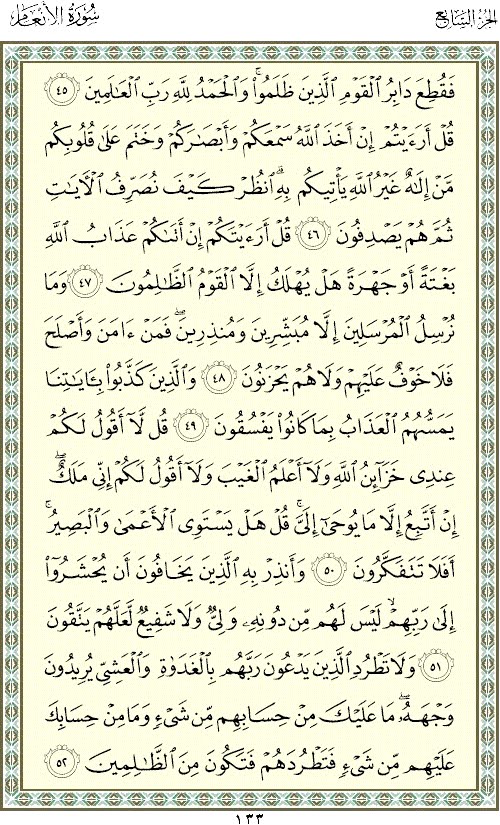
Sunday, July 24, 2011

6:47

Salaam all,


Qul araaytakum in atakum AAathabu Allahi baghtatan aw jahratan hal yuhlaku illa alqawmu alththalimoona

The Aya says:
Say (O Muhammad): have you (plural) seen if Allah’s wrath came to you suddenly or clearly, Will other than the unjust people perish?!

My personal note:
The Aya is a reassurance to humanity that Allah does not punish and cause to perish except for the unjust.

Translation of the transliterated words:
Qul: Say/ communicate/respond
Note: the root is Qaf-W-L and it means saying or communicating. QUL is an order or a request addressed to a singular. It means: say or communicate.
Araaytakum: have you (singular) seen you (plural)?
Note: the root R-Hamza-Y and it means viewing or seeing. ARAAYTAKUM is a question about an action that is completed. It means: the question is posed to a singular and it means: Have you (singular) seen you (plural) basically asking the singular (muhammad) about seeing the plural (his society).

In: if
Atakum: came to you (plural)
Note: ATAKUM is derived from the root Hamza-T-Y and it means in concrete the water that comes from the rain of another land. In a conceptual manner, it means the coming of something or someone with many of it’s implications. ATA is an action that was completed. It means: the action of coming happened by the subject (AAaTHABU ALLAHI= Allah’s torture/ suffering) to the object (Kum= plural you).

AAathabu: suffering of/ torture of
Note: the root is Ain-TH-B and it means an easy to swallow food or drink. AAaTHAB is what makes one not take an easy to swallow food or drink. That is suffering.
Allahi: Allah
Baghtatan: suddenly/ unprepared/ unannounced
Note: the root is B-Ghain-T and it means sudden or coming as a surprise when one is unprepared and so on. BAGHTATAN means suddenly.

Aw: or
Jahratan: loudly/ announced/ clearly
Note: The root is J-H-R and it means to make things apparent and wide open with the aim of it being noticed and not missed. This is then is taken conceptually to mean any unhidden or loud expression in voice or vision and so on. JAHRATAN means the loud/ clear and unhidden and apparent of.
hal yuhlaku: will be made to perish?!
Note: HAL is indicative that a question is being asked. YUHLAKU is derived from the root H-L-K and it means dried and dead plant. This is the concrete and the abstract means death and perdition. YUHLAKU is an action that is being completed or will be completed. It means: the action of causing the object’s (ALQAWMU ALTHTHAIMOON= the unjust people) death/ demise or perdition is happening or will be happening by an undeclared subject.

Illa: except/ other than/ if not
alqawmu: the people/ group
Note: the root is Qaf-Y-M and it means standing or standing upright. ALQAWM are the people that stand together and that makes the group or people or nation, basically, any group of people that stand together. Here. It points to the particular group that wants to get away from their obligation to fight.
alththalimoona: the unjust
Note: the root is THA-L-M and it means darkness in the most concrete form. This word also takes the meaning of misplacing right from wrong and transgression or injustice since injustice is displacing right from wrong and a decision made in darkness. ALTHTHALIMOON are the unjust or the one who misplaces right from wrong intentionally and that is the one who decides and acts in darkness.

Salaam all and have a great day.

Hussein

Friday, July 22, 2011

6:46

Salaam all,


Qul araaytum in akhatha Allahu samAAakum waabsarakum wakhatama AAala quloobikum man ilahun ghayru Allahi yateekum bihi onthur kayfa nusarrifu alayati thumma hum yasdifoona


The Aya says:

Say (O Muhammad) have you (plural) envisioned if Allah took away your hearing and your vision and sealed upon your hearts. What entity worthy of worship other than Allah will bring it back to you?! Look (O Muhammad) how we manage the signs, then they close themselves off.

My personal note:
The Aya brings to our attention that if Allah took away something from us, then no one but Him will bring it back.

One may then wonder about medical advances that allowed people to hear and to see after having been deaf and mute and blind. The answer here would be that this is done with Allah’s knowledge and permission in those cases and therefore it is Allah ultimately that brought back the vision and the hearing. Of course there are many conditions where medicine cannot help bring back the hearing and the vision. It is only in limited situations.

However, the Aya is also pointing out to the original entity that gave us the vision and the hearing and that it is the one that is worthy of worship. It points to things that we may be taking for granted all the time and we appreciate only when we loose them.

May Allah help us stay conscious of Him and the blessings that He bestowed upon us so as to be thankfull all the time.

Translation of the transliterated words:
Qul: Say/ communicate/respond
Note: the root is Qaf-W-L and it means saying or communicating. QUL is an order or a request addressed to a singular. It means: say or communicate.
Araaytum: have you (singular) seen you (plural)/envisioned?
Note: the root R-Hamza-Y and it means viewing or seeing. ARAAYTUM is a question about an action that is completed. It means: the question is posed to a singular and it means: Have you seen (plural).

In: if
akhatha: He took them
Note: AKHATHA is an action that is completed. It means: the action of taking the object (Samaaakum=your hearing/ comprehension) is completed by the subject (third person singular).
Allahu: Allah
samAAakum: your (plural) hearing/ comprehension
Note: The root is S-M-Ain and and it means hearing or hearing and understanding or knowing and retaining at the same time. It also can mean hearing and approving or concurring at times. SAMaAAa means hearing of but can be extended to comprehension or responsiveness of. KUM is plural you.

Waabsarakum: and your vision/ insight
Note: WA is a letter that links what is before with what is after. This link is through inclusion, either one is included in the other or they are all included in the bigger sentence or bigger picture. WA often corresponds with “and/ addition” but the more encompassing meaning is in inclusion one in another or all in a bigger picture or sentence. BASARAKUM is derived from the root B-Sad-R and it is the sense of the eye. It also has the meaning of seeing deeply. Seeing deeply means the concrete, but it can be applied to the deep vision of the brain, the insight. BASARA means vision of or insight of. KUM means plural you.
Wakhatama: and He sealed/ including He sealed
Note: WA is a letter that links what is before with what is after. This link is through inclusion, either one is included in the other or they are all included in the bigger sentence or bigger picture. WA often corresponds with “and/ addition” but the more encompassing meaning is in inclusion one in another or all in a bigger picture or sentence. KHATAMA is derived from the root Note: KH-T-M means to seal something shut so that nothing can get in or out of it. It is used often to mean that something is finished, since one seals something when it finished and it is also conceptually used to give a well demarcated sign or feature of an entity and so on. KHATAMA is an action that is completed. It means: the action of sealing the object (Aaala Quloobikum= upon your hearts) happened by the subject (third person singular).

Aaala: upon
quloobikum: your hearts/ hearts and minds
Note: The root is Qaf-L-B and it means turning 180 degrees or upside down. The word is used for heart, because it is the organ that changes it’s moods often. Therefore QALB is our thoughts and emotions. QULOOBI are hearts and minds of or thoughts and emotions of. KUM means plural you.
Man: who?
Ilahun: God/ entity worthy of worship
Ghayru: other than
Note: GHAYR is derived from the root GH-Y-R and it means different or other. GHAYR means other than.
Allahi: Allah
Yateekum: brings to you/ comes to you
Note: the root is Hamza-T-Y and it means in concrete the water that comes from the rain of another land. In concrete it means the coming of something or someone with many of it’s implications. YATEE is an action that is being completed or will be completed. It means: the action of coming of the subject (third person singular) will arrive to the object (second person plural).

Bihi: by him/ With him
Note: Bi suggests that what comes after it is either an association with the action, a tool of the action or an object of the action or any combination of the three. If bi serves as an object of the action that it serves as an emphasis of the action. HI means him and it points to what they own that they offer for ransom. The Him is pointing to what they lost as hearing and vision and hearts. YATEEKUM BIHI takes the meaning of bring him to you rather than coming with them.

onthur : see/ watch/ observe
Note: the root is N-THa-R and it means seeing/observing/watching with one side of the meaning stronger than the others according to the situation. At times it means giving reprieve or giving time to correct things and that stems from the observing/watching as if it is time of observation/watching or waiting. OTHUR is an order addressed to a gsingular. It means: watch or see or observe
Kayfa: how
Nusarrifu: We manage/ We move about
Note: the root is Sad-R-F and it means: the moving or managing of an entity. NUSARRIF is an action that is being completed or will be completed. It means: the action of making the object (AlAYATI= the signs) managed or moved about is happening or will be happening by the subject (first person plural).

alayati: the signs
Note: AYAT is derived from the root Hamza-Y-H and it means sign. ALAYATI means the signs.
Thumma: then
Hum: they
Yasdifoona: Move away/ hide away/ close themselves off
Note: the root is Sad-D-F and it means in concrete the sea shell that hides the pearls inside or other sea animals. Conceptually, it is used for hiding away or moving away from something as if closing themselves inside the shell. YASDIFOON is an action that is being completed or will be completed. It means: the action of closing themselves off is happening or will be happening by the subject (third person plural).

Salaam all and have a great day.

Hussein

Sunday, July 17, 2011

6:45

Salaam all,


FaqutiAAa dabiru alqawmi allatheena thalamoo waalhamdu lillahi rabbi alAAalameena

The Aya says:
So, the line of the people who were unjust was cutoff. And the praise belongs to Allah, Nurturing Lord of All.

My personal note:
I translated the statement “Qutiaa Dabir” as the line was cutoff. This combination of words carries with it that the group talked about will have “it’s behind cutoff”. The “behind” here means that there is nothing coming out after them that belongs to them and therefore they will have no offspring and no one to carry their identity, thought and so on.

The Aya describes them as unjust which is the description that Allah gives in the Qur’an to sinners in general and in this case, they are great sinners. It also ends up with The praise belongs to Allah which is a statement used for the beginning of things and for the end of things, but it also reemphasizes that the act of cutting off their line is an act deserving of praise, especially as it describes them as unjust.

Translation of the transliterated words:
FaqutiAAa: therefore was cut
Note: FA means therefore or so or then. QUTiAAa is derived from the root Qaf-TTa-Ain and it means cutting as a conceptual meaning which can be very concrete or differently. In this sentence, it is used more to mean make go away or disappear. QUTiAAa is an action that is completed. It means: the action of cutting the object (Dabir= behind) happened by an undeclared.

Dabiru: behind/ following/ offspring
Note: the root is D-B-R and it means the end of an entity in a conceptual manner. This could be the behind of the entity or it could be the conclusion of a matter or business and so forth. DABIRU means: behind of. In this context, it is talking cutting off any consequence to them in term of offspring or following and so on..
alqawmi: the people/ group
Note: the root is Qaf-Y-M and it means standing or standing upright. ALQAWM are the people that stand together and that makes the group or people or nation, basically, any group of people that stand together. Here. It points to the particular group that wants to get away from their obligation to fight.

Allatheena: who/ those who
Thalamoo: were unjust/ trransgressed
Note: the root is THA-L-M and it means darkness in the most concrete form. This word also takes the meaning of misplacing right from wrong and transgression or injustice since injustice is displacing right from wrong and a decision made in darkness. THALAMOO is an action that is completed. It means: the action of being or acting unjustly or misplacing right and wrong happened by the subject (third person plural).

waalhamdu: while the praise/ and the praise
Note: WA is a letter that links what is before with what is after. This link is through inclusion, either one is included in the other or they are all included in the bigger sentence or bigger picture. WA often corresponds with “and/ addition” but the more encompassing meaning is in inclusion one in another or all in a bigger picture or sentence. ALHAMDU is derived from the root Ha-M-D and it means praise or thanks. According to the understanding of scholars an entity receives HAMD for her actions, words, or just attributes that are praiseworthy. ALHAMDU means, the praise.
Lillahi: belongs to Allah
Rabbi: nurturing Lord of
Note: RABBIis derived from the root R-B-B and it means nurturing and Lordship as two components of the meaning that can be present together or one at a time according to the context of the sentence. RABBI is nurturing Lord of.
alAAalameena: the beings/ the factual entities/ all
Note: the root is Ain-L-M and it means knowing/knowledge or knowledge of facts. ALAAaLAMEENA are the knowns and that includes all factual entities.


Salaam all and have a great day.

Hussein

Thursday, July 14, 2011

6:44

Salaam all,


Falamma nasoo ma thukkiroo bihi fatahna AAalayhim abwaba kulli shayin hatta itha farihoo bima ootoo akhathnahum baghtatan faitha hum mublisoona

The Aya says:
So when they abandoned what they were reminded of, We opened upon them doors of everything. Untill when they became delighted with what they were given, We took them suddenly, so then they are broke.

My personal note:
This Aya in combination with the previous Ayat seem to give an idea of the workings of how God gives us warnings and so on. The previous Ayat suggest that He will make us suffer a little to remember Him and to ask for his help, but when some humans forget or abandon His warnings and teachings, They may live a good life until they are taken by God and then they are completely broke without resources but also without acceptable excuses for their behavious and actions.

It is a message to all humanity that living a prosperous life is not a proof of living in harmony with God, nor is it a proof that the person is safe from the punishment of God despite his aggression and misbehavior. It is a matter of time before he or she is taken by God.

The word MUBLIS is used here and it means: when the person has no excuses of acceptable explanations for his or her bad actions and behaviours. It also carries with it the lack of hope of a reprieve. May Allah prevents us from being Mublis on that day.

Translation of the transliterated words:
Falamma: so when
Nasoo: they forgot/ they abandoned
Note: NASOO is derived from the root N-S-Y and it is the one used for women. This same root is used for the sciatic nerve as a concrete word and for forgetting or abandoning an entity. The relation between the different meanings is only in an indirect manner. The use here is for abandoning or forgetting. NASOO is an action that is completed. It means: the action of forgetting or abandoning the object (MA THUKKIROO BIHI= what they were reminded of) happened by the subject (third person plural).
Ma: what
Thukkiroo: they were reminded and mentioned to
Note: the root is TH-K-R and it means mention and remember, at the same time. The concrete word is something running on the tongue as if speaking it. Another concrete word is male or the male organ. The relationship between the two is not very clear and they can be different words that share the sound but have different root. It could be that the male is considered the active organ and that memory is an active process, but that is only a theory. THUKKIROO is an action that is completed. It means: the action of reminding and mentioning to the object (third person plural) of another object (BIHI= in him pointing to the book) happened by the subject (undeclared).

Bihi: by him/ With him
Note: Bi suggests that what comes after it is either an association with the action, a tool of the action or an object of the action or any combination of the three. If bi serves as an object of the action that it serves as an emphasis of the action. HI means him and it points to announcing the food.
Fatahna: We opened/ We provided
Note: the root is F-T-Ha and it means to open for the verb and opening for the noun. The concept that it carries are either opening or relieving from pressure which includes a gain or win. FATAHNA is an action that is completed. It means: the action of opening the object (ABWABA= doors) happened by the subject (first person plural)..

Aaalayhim: upon them
Abwaba: doors of
Note: the root is B-W-B and it means door or gate. ABWABA means doors or the gates of.

Kulli: every/ each
Note: KULLI is derived from the root K-L-L and it means the parts put together. This is the concrete and it means all or every or each. It can also be extended conceptually to mean the parts surrounding an entity. KULLI means every, or each.
Shayin: entity/ thing
Note: the root is SH-Y-Hamza and it means entity. SHAYIN means entity. It is taken here to mean a thing or entity
Hatta: untill
Itha: when
Farihoo: they delighted
Note: the root is F-R-Ha and it means delight. This could be positive or negative according to the reason for the delight that one attains. FARIHOO is an action that is completed. It means: the action of delighting happened by the subject (third person plural)

Bima: by what/ with what/ in what
Note: Bi denotes that what comes after is a tool and/or an object or an association with an action that was mentioned. If it is an object of the action then it makes it stronger. MA means what
Ootoo: they were given/ were brought
Note: the root is Hamza-T-Y and it means coming with determination. The concrete word is for the water that flows in a place where it did not rain, therefore suggesting that the water came from somewhere else. OOTOO is a completed action that is derived from the root. It means: the action of coming happened to the object (third person plural) by an undisclosed subject. It then means literally: they were brought/something was made to come to them.

Akhathnahum: We took them
Note: AKHATHNA is an action that is completed. It means: the action of taking the object (HUM= them) is completed by the subject (third person plural pointing to Allah or Allah and whoever works under him).

Baghtatan: suddenly/ unprepared/ unannounced
Note: the root is B-Ghain-T and it means sudden or coming as a surprise when one is unprepared and so on. BAGHTATAN means suddenly.
Faitha: so then
Hum: they
Mublisoona: broke/ without resources/ without response/hope
Note: the root is B-L-S and it means the lack of hope or lack of reasonable answer or response. MUBLISOONA are the ones who have no answer and or no hope.

Salaam all and have a great day.

Hussein

Monday, July 11, 2011

6:43

Salaam all,


Falawla ith jaahum basuna tadarraAAoo walakin qasat quloobuhum wazayyana lahumu alshshaytanu ma kanoo yaAAmaloona

The Aya says:
So why did they not plead? As our hardship came to them. But their hearts became hard, and Satan ornamented to them what they happened to do.

My personal note:

The Aya somehow suggests that people may be two types. A group that pleads to Allah to help them when they are hit by hardship and a group that continues to desist despite the hardship. The Qur’an in this Aya points to the second group as one with hard hearts and therefore not responsive and that Satan made it appear to them that their actions are correct and beautiful and he ornamented their actions to them.

Translation of the transliterated words:
Falawla: so why not?!
Ith: as/ when
Jaahum: came to them
Note: the root is J-Y-Hamza and it means coming. One concrete word that is derived from this word is the pool where the rain water comes. JAA is an action that is completed and that is derived from the root. It means that the action of coming happened by the subject (third person singular pointing to ALHAQQI= the binding truth) to the object (HUM=them)
Basuna: our hardship
Note: BASUNA is derived from the root B-Hamza-S and it means lion for concrete. The word is used to mean hardship or hard depending on the situation. BASUNA means our hardship or the hardship that came from us.

tadarraAAoo: they pleaded/ they pled
Note: the root is Dhad-R-Ain and it carries in the concrete the feeling of weakness and awareness of weakness and need. One concrete meaning is the breast feeding infant and so he is pleading and is in great need for the milk. Also, the fact that the breast milk will provide food that is only adequate to the very young and therefore not sufficient. Conceptually, it is used for people who know their great need and are asking with humility and with pleading. It is also conceptually used for situation where the need is great and the suppy is meager. TADARRaAAoo is an action that is completed. It means: the action of making oneself plead happened by the subject (third person plural).

Walakin: but instead
Qasat: became hard
Note: the root is Qaf-S-W and it means to become hard for the verb and hardness for the noun. QASAT is an action that is completed. It means: the action of the subject (third person plural pointing to Quloobuhum= their hearts and minds/ their thought and emotion) becoming hard happened.

quloobuhum: their hearts/ hearts and minds
Note: The root is Qaf-L-B and it means turning 180 degrees or upside down. The word is used for heart, because it is the organ that changes it’s moods often. Therefore QALB is our thoughts and emotions. QULOOBU are hearts and minds of or thoughts and emotions of. HUM means them.
Wazayyana: and he beautified/ and he ornamented
Note: WA is a letter that links what is before with what is after. This link is through inclusion, either one is included in the other or they are all included in the bigger sentence or bigger picture. WA often corresponds with “and/ addition” but the more encompassing meaning is in inclusion one in another or all in a bigger picture or sentence. ZAYYANA is derived from the root Z-Y-N and it means what one puts on to add beauty to the look. It is used to cover clothes, jewelry and make up. For the land, it is the grass and the flowers. ZAYYANA is an action that is completed that is derived from the root. It means: the action of beautifying or ornamenting the object (LAHUM= to them) was made to happen by the subject (third person singular pointing to Satan).

Lahumu: to them/ for them
alshshaytanu: Satan/ the one that is displaced from God’s mercy and works on displacing others.
Note: the root is SH-Ta-N and it means in one of the concrete meanings the long rope and in another the long rope at the well that one uses to get the bucket out of the water. The term is used to mean far and away (in all the planes of thought) as the long rope and it is also used for displacement or pulling away, as a parallel to the rope that pulls the bucked out of the water. ALSHAITAN is the one who is far or away (from God’s mercy) and who works at pulling others away through his long “rope”. It is the word used from Satan.
Ma: what
Kanoo: they happened to be
Note: the root is K-W-N and it means being. KANOO is an action that is completed that is derived from the root. It means: the action of being happened by the subject (third personal plural). This in turn means: they were or they happened to be
yaAAmaloona: they do/ doing
Note: the root is Ain-M-L and it means doing or work. YaAAMALOONA is an action that is being completed or will be completed. It means: the action of doing or making is happening or will be happening by the subject (third person plural).

Salaam all and have a great day

Hussein

Friday, July 08, 2011

6:42

Salaam all,


Walaqad arsalna ila omamin min qablika faakhathnahum bialbasai waalddarrai laAAallahum yatadarraAAoona

The Aya says:
And We indeed envoyed to nations before you (singular), so we took them by the hardship including the harm, perhaps they plead.

My personal note:
This Aya suggests that sometimes but not always, when we are tested by hardship or harm, it is in order to help us remember Allah and come to him pleading for help. So, the pain of the hardship may lead to a greater good to some people if they ended up returning to their Lord and becoming much closer to their Lord than before.

There is a new word here and that is yatadarraaaoon and I translated it as pleading. The word is used for when someone asks for help when he or she knows his great need and also his lack of resources. One concrete usage of the term is breast feeding infant who sometimes looks to be pleading to feed but also that the breast milk is only sufficient for the young infant and not further and therefore not an adequate resource for life beyond infancy.

Translation of the transliterated words:
Walaqad: and indeed
Arsalna: We sent/ We envoyed
Note: ARSALNA is derived from the root R-S-L and it means to envoy someone or a group of people or animals. The concrete word is RASL and it means a group of people or animals that were sent by their owners or senders. ARSALNA is an action that is completed. It means: the action of sending or envoying happened by the subject (first person plural).

Ila: to/ towards
Omamin: nations/ groupings
Note: OMAM is derived from the root Hamza-M-M and it means mother or sources/origin if said as UMM and destination if said as AMM. OMAM means in this context nations or groupings and that is because it is a group that have the same origin and is moving to the same destination.

Min: from
qablika: before you (singular pointing to Muhammad pbuh)
Note: the root Qaf-B-L and it means front. This is then carried in time or space or any plain of thought. If it is in time, then front means before, while place would be in front. It is used to mean acceptance and reception since we receive and accept using our fronts. QABLI here is front in time and that is before of. KA means singular you and points to Muhammad (pbuh).
Faakhathnahum: so we took them
Note: FA means so or therefore or then. AKHATHNA is derived from the root root Hamza-KH-TH and it means taking. AKHATHNA is an action that is completed. It means: the action of taking the object (HUM= them) is completed by the subject (third person plural pointing to Allah or Allah and whoever works under him).

Bialbasai: by the hardship
Note: Bi suggests that what comes after it is either an association with the action, a tool of the action or an object of the action or any combination of the three. If bi serves as an object of the action that it serves as an emphasis of the action. ALBASAI is derived from the root B-Hamza-S and it means lion for concrete. The word is used to mean hardship or hard depending on the situation. ALBASAI means the hardship
Waalddarrai: and the harm/ including the harm
Note: WA is a letter that links what is before with what is after. This link is through inclusion, either one is included in the other or they are all included in the bigger sentence or bigger picture. WA often corresponds with “and/ addition” but the more encompassing meaning is in inclusion one in another or all in a bigger picture or sentence. ALDDARRAI is derived from the root Dhad-R-R and it means to harm or opposite of benefit. Concrete word is DAREER and it means blind person or a person that is afflicted with weakness and illness. Conceptually, it covers any kind of significant harm or affliction. ALDARRAI is the harm or affliction.

laAAallahum: perhaps they
yatadarraAAoona: plead
Note: the root is Dhad-R-Ain and it carries in the concrete the feeling of weakness and awareness of weakness and need. One concrete meaning is the breast feeding infant and so he is pleading and is in great need for the milk. Also, the fact that the breast milk will provide food that is only adequate to the very young and therefore not sufficient. Conceptually, it is used for people who know their great need and are asking with humility and with pleading. It is also conceptually used for situation where the need is great and the suppy is meager. YATADARRaAAooNA is an action that is being completed or will be completed. It means: the action of making oneself plead is happening or will be happening by the subject (third person plural).


Salaam all and have a great day.

Hussein

Wednesday, July 06, 2011

6:41

Salaam all,


Bal iyyahu tadAAoona fayakshifu ma tadAAoona ilayhi in shaa watansawna ma tushrikoona

The aya says:
But yes, You call Him, so he clears away what you call for, if He willed and you forget/ abandon what what you used to partner.

My personal note:
This Aya reiterates the answer to the previous Aya with strong affirmation that when we are at a time of great need and suffering, we will tend to ask Allah to remove the suffering and we forget all the other entities that we may have called upon for aid previously.

The Aya delves deeply into our psyche and unconsciousness and it tells us that deep inside, we know that only God has the ability to help us at a time of need and therefore only God deserves to be worshipped and that includes being called upon for help in addition to other acts of worship

Translation of the transliterated word:
Bal: but yes/ indeed
Iyyahu: HE
tadAAoona: you (plural) call upon
Note: the root is D-Ain-Y and it means calling as in calling someone for help or otherwise. TADAAooNA is an action that is being completed or will be completed. It means that the action of calling or calling upon is happening or will be happening by the subject (second person plural) of the object (IYYAHU= He)

Fayakshifu: So He removes/ He clears away
Note: FA means therefore or then or so. YAKSHIFU is derived from the root K-SH-F and it means removing or clearing what was a cover or barrier either to vision or other forms. Conceptually it takes the different meanings of mainly remover of harm or remover of barrier to vision or other forms of perception. YAKSHIFU is an action that is being completed or will be completed. It means: The action of clearing what is being asked to be cleared is happening or will be happening by the subject (Third person singular pointing to Allah).

Ma: what
tadAAoona: you (plural) call upon
Note: the root is D-Ain-Y and it means calling as in calling someone for help or otherwise. TADAAooNA is an action that is being completed or will be completed. It means that the action of calling or calling upon is happening or will be happening by the subject (second person plural) of the object (ILAYHI= towards him) .
Ilayhi: towards him/ for
In: if
Shaa: He willed/ He entitied
Note: the root is Sh-Y-Hamza and it means entity. SHAA is an action that is completed that is derived from the root. It means that the action of entitying happened by the subject (third person singular). Therefore it means: He entitied and in this context, it takes the meaning He willed.

Watansawna: and you (plural) forget/ abandon/ leave
Note: WA is a letter that links what is before with what is after. This link is through inclusion, either one is included in the other or they are all included in the bigger sentence or bigger picture. WA often corresponds with “and/ addition” but the more encompassing meaning is in inclusion one in another or all in a bigger picture or sentence. TANSAWNA is derived from the root N-S-Y and it is the one used for women. This same root is used for the sciatic nerve as a concrete word and for forgetting or abandoning an entity. The relation between the different meanings is only in an indirect manner. The use here is for abandoning or forgetting. TANSAWNA is an action that is being completed or will be completed. It means: the action of forgetting or abandoning the object (MA TUSHRIKOON= what you associate) is happening or will be happening by the subject (second person plural).

Ma: what
Tushrikoona: you make partner/ you associate
Note: the root SH-R-K and it means partner or partnership and with this partnership is a measure of equality or being on par. TUSHRIKOONA is an action that is being completed or will be completed. It means: the action of making partner to the object (not declared but point to Allah) is happening or will be happening by the subject (second person plural).


Salaam all and have a great day.

Hussein

Monday, July 04, 2011

6:40

Salaam all,


Qul araaytakum in atakum AAathabu Allahi aw atatkumu alssaAAatu aghayra Allahi tadAAoona in kuntum sadiqeena

The Aya says:
Say (O Muhammad): have you (singular) seen if Allah’s punishment came to you (plural) or the hour came to you (plural), Do you (plural) call upon other than Allah?! If you (plural) were truthful?!

My personal note:
This Aya is a reminder that whenever suffering hits humans or times of great testing and anxiety then the only entity they turn to is Allah. It is a reminder that if that is what we do in time of great need then we should do it at all times as well.

The Aya starts with a form of ARAAYTAKUM that sounds as if It is talking to a singular when it is addressing the plural. This is a form of Arabic that brings more attention to the discussion by talking to the plural with the singular form and then indicating that it is pointing to the plural.

Translation of the transliterated words:
Qul: Say/ communicate/respond
Note: the root is Qaf-W-L and it means saying or communicating. QUL is an order or a request addressed to a singular. It means: say or communicate.
Araaytakum: have you (singular) seen you (plural)?Note: the root R-Hamza-Y and it means viewing or seeing. ARAAYTAKUM is a question about an action that is completed. It means: the question is posed to a singular and it means: Have you (singular) seen you (plural) basically asking the singular (muhammad) about seeing the plural (his society).

In: if
Atakum: came to you (plural)
Note: ATAKUM is derived from the root Hamza-T-Y and it means in concrete the water that comes from the rain of another land. In a conceptual manner, it means the coming of something or someone with many of it’s implications. ATA is an action that was completed. It means: the action of coming happened by the subject (AAaTHABU ALLAHI= Allah’s torture/ suffering) to the object (Kum= plural you).

AAathabu: suffering of/ torture ofNote: the root is Ain-TH-B and it means an easy to swallow food or drink. AAaTHAB is what makes one not take an easy to swallow food or drink. That is suffering.
Allahi: Allah
Aw: or
atatkumu: came to you (plural)
Note: ATATKUM is derived from the root Hamza-T-Y and it means in concrete the water that comes from the rain of another land. In a conceptual manner, it means the coming of something or someone with many of it’s implications. ATAT is an action that was completed. It means: the action of coming happened by the subject (ALSSaAAaTU= the hour) to the object (Kum= plural you).

alssaAAatu: the time/ the hour
note: The root is S-W-Ain and it means a portion of the day or night. It is used for the hour but it can be used for any portion of time. ALSSaAAaTU means the hour and in this context it points to the hour of the day of judgment.
Aghayra: other than?
Note: GHAYR is derived from the root GH-Y-R and it means different or other. AGHAYR means other than mentioned in a form of question mark that also carries with it exclamation.

Allahi: Allah
tadAAoona: you (plural) call upon
Note: the root is D-Ain-Y and it means calling as in calling someone for help or otherwise. TADAAooNA is an action that is being completed or will be completed. It means that the action of calling or calling upon is happening or will be happening by the subject (second person plural) of the object (Aghayra Allah= other than Allah?) .

in: if
Kuntum: you (plural) were/ you happened to be
Note: the root is K-W-N and it means being. KUTUM is an action that is completed that is derived from the root. It means: the action of being happened by the subject (second person plural). This in turn means: You (plural) were or you happened to be.
Sadiqeena: Truthful/ people of truth
Note: the root is Sad-D-Qaf and it means truth in word or deed as a concept. When it is in deed, it takes the shape of any act of truthfulness including charity. SADIQEENA means people of truth or truthful.


Salaam all and have a great day.

Hussein